
The One-In-One-Out Rule: A Real Decluttering Method for Small Apartments Before Fall
Check out how the one-in-one rule works and see the best strategies to apply this on your next fall's routine!
Most articles about the One-In-One-Out Rule credit it to “professional organizers” in general, like it’s folk wisdom nobody actually invented. That’s not quite true.
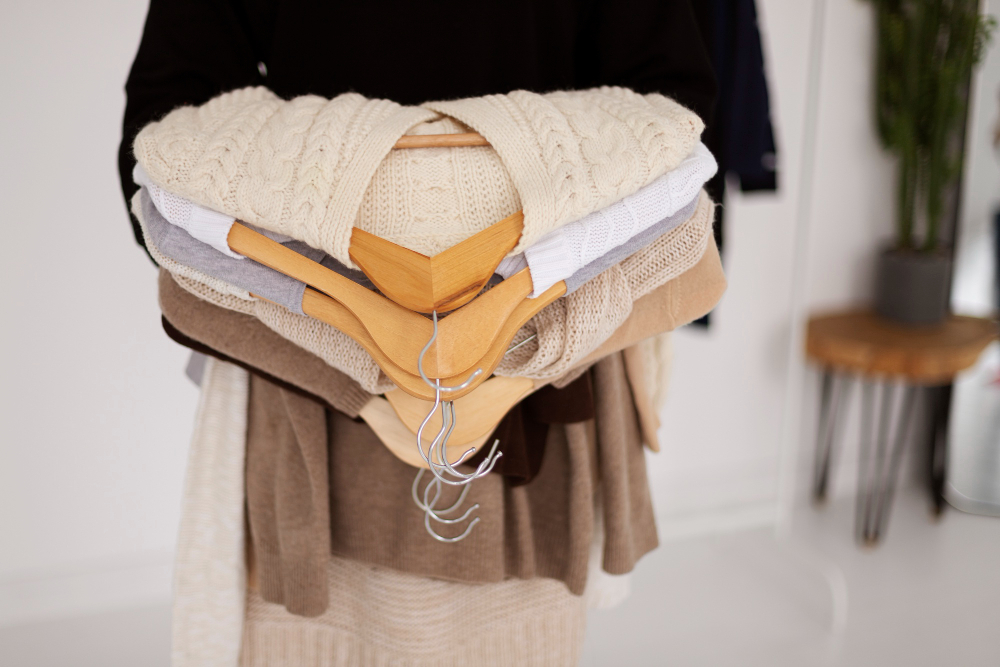
It comes from a specific person, a specific book, and a specific bigger idea that most of those articles leave out entirely. Photo by Freepik.
Where the rule actually comes from
The bigger idea the rule sits inside
Inside that book is a bigger framework she calls the Container Concept.
Every space you own, a shelf, a drawer, a closet, a whole room, is a container with a fixed size. Once it’s full, it’s full.
The One-In-One-Out Rule is what she uses to enforce that limit, describing it this way: if a container is full and she needs to put something in it, she has to remove something from the container to make room.
That’s the part almost every listicle skips. The rule isn’t really about swapping one sweater for another sweater.
It’s an enforcement mechanism for the idea that your space has a hard ceiling, and pretending otherwise is how clutter happens in the first place.
Why this matters more in a small apartment
No spare container to hide in
In a house with a garage, an attic, and a spare room, a full container just means you use a different container.
In a small apartment, there usually isn’t a different container. The kitchen cabinet is the only kitchen cabinet.
The single closet is the only closet.
That’s exactly the situation the rule was built for, even though White wrote it with any home in mind.
The smaller the space, the less room there is to hide from the rule, and the more it actually forces a decision instead of a shuffle.
What happens when people skip this and just rent more space
The instinct to rent a bigger container
Here’s the part that ties directly into your wallet. When a small space runs out of room, a lot of people don’t declutter, they rent a bigger container somewhere else.
Self-storage is a massive industry built almost entirely on this instinct.
A standard 10×10 unit runs somewhere around $120 to $135 a month on average nationally, and pricing climbs sharply in expensive metro areas.
Why people actually rent one
The single most common reason people give for renting a unit isn’t a move or a life event. It’s simply not having enough space at home.
And once people start, they tend to keep paying: the average storage renter keeps their unit for well over a year, often close to a year and a half.
The math most people never do
A $130-a-month unit, kept for 18 months, is roughly $2,340 spent to store things you decided not to decide about.
The One-In-One-Out Rule is, in a very literal sense, the free alternative to that bill.
The science: it’s not the mess itself, it’s how you talk about it
There’s real research connecting clutter to stress, but the actual finding is more specific and more interesting than the version that goes around online.
The UCLA study everyone oversimplifies
Psychologists Darby Saxbe and Rena Repetti studied 60 dual-income couples for UCLA’s Center on Everyday Lives of Families, published in Personality and Social Psychology Bulletin in 2010.
Their method was clever: they had each spouse give a recorded home tour, then ran the transcripts through linguistic analysis software to score how “stressful” or “restorative” the language was, based on words like “mess” and “unfinished” versus calmer, more restful language.
What they actually found
The finding wasn’t simply “more stuff equals more stress.”
It was that wives who described their homes in more stressful language showed a flatter diurnal cortisol slope over the following days, a pattern linked to worse long-term health outcomes.
Husbands, on average, didn’t show the same pattern.
The clutter mattered less than whether a person had come to experience their home as a source of stress versus a source of recovery.
Why that distinction matters for you
That nuance changes how you should use the rule. It’s not really about hitting some objective number of possessions.
It’s about whether your space still feels like it works for you, or like it’s a running list of unfinished business every time you look at it.
Before fall, see how to do a self-care routine for the last weeks of summer.
The honest limitation nobody mentions
The rule has a real weak spot, and being upfront about it will save you frustration.
One-In-One-Out is maintenance, not rescue. It assumes you’re already starting from a reasonably organized space and just need a system to keep it that way.
If your apartment is genuinely overwhelmed with excess stuff, swapping one item for one item at a time will take a very long time to make a visible dent.
For that situation, a real decluttering pass first, then switching to the rule to maintain the result, works far better than trying to use the rule as your first move.
How to actually run it before fall
Do one real pass first if you need to
If your apartment already feels out of control, don’t start with One-In-One-Out. Clear a genuine backlog first, then switch to the rule for maintenance.
Apply it to like-for-like categories
It works best with clothes, books, kitchen gear, and anything else you have multiples of. A new sweater displaces an old sweater. A new mug displaces an old mug.
Decide the exit before the entrance
When something new comes in, pick what’s leaving before you even unpack the new item. Waiting until later is how the rule quietly stops happening.
Give the outgoing item a real destination
Donate, sell, or hand it off the same week. An item sitting “to be dealt with” in a corner isn’t out, it’s just relocated clutter.
Use the fall timing on purpose
Between summer’s looser routines ending and the winter gear about to compete for the same closet space, early fall is a natural checkpoint to confirm the container is still winning.
Frequently asked questions
How we verified this
The rule’s origin was confirmed against Dana K. White’s own book and publisher listings.
The UCLA study is Saxbe and Repetti’s peer-reviewed paper in Personality and Social Psychology Bulletin. Self-storage pricing and usage figures come from current industry data trackers, cross-checked across multiple sources given how widely these figures vary by source.
This article is for general information and is not professional organizing or financial advice.
Sources
- Origin of the One-In-One-Out Rule and the Container Concept: Dana K. White, “Decluttering at the Speed of Life: Winning Your Never-Ending Battle with Stuff” (Thomas Nelson, 2018), and author biography via Goodreads (https://www.goodreads.com/author/show/11013376.Dana_K_White).
- Clutter, language, and cortisol patterns in couples: Saxbe, D. E., and Repetti, R., “No Place Like Home: Home Tours Correlate With Daily Patterns of Mood and Cortisol,” Personality and Social Psychology Bulletin, 2010 (https://journals.sagepub.com/doi/10.1177/0146167209352864), and UCLA Magazine’s coverage of the CELF research (https://newsroom.ucla.edu/magazine/center-everyday-lives-families-suburban-america).
- Self-storage pricing, usage reasons, and average rental duration: SpareFoot (https://www.sparefoot.com/blog/self-storage-industry-statistics) and HireAHelper (https://www.hireahelper.com/advice/self-storage-statistics/).
- The rule’s limitation as a maintenance-only method: The Spruce, via AOL (https://www.aol.com/lifestyle/why-ditched-one-one-rule-165100890.html).

Gabriel is a writer with a decade of experience in the newsroom and beyond. He has covered just about everything, but over the past five years he has built a clear focus on two beats: finance and travel. He earned his Communications degree from Unicamp, spent six months at Fontys in the Netherlands, and holds a postgraduate degree in Journalism. He is currently pursuing a master's degree at the University of Lisbon, where he continues to sharpen his perspective on communication and content.