
August Has Zero Federal Holidays: What That Actually Means for Your Month
August is the one full month of the year with no federal holiday on the calendar. The last one was Independence Day, observed Friday, July 3, and the next is Labor Day on Monday, September 7.
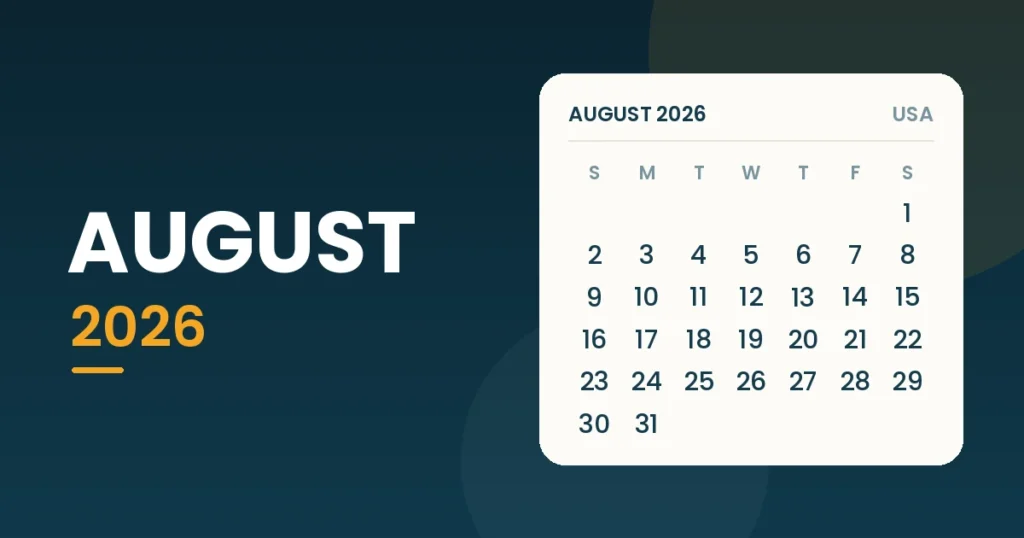
That leaves a stretch of roughly two months with no day off, and August sits square in the middle of it. A quiet calendar is not the same as an empty one. Photo by Freepik.
There are 11 federal holidays in 2026, and none of them fall in August. After the July 4 weekend, the calendar simply goes quiet until early September.
What makes 2026 notable is where Labor Day lands: September 7 is the latest date the first Monday of September can fall on, which stretches the gap to its maximum and gives you the longest possible run of summer before the next long weekend.
Below is what that gap means in practice, for your time off, your money, and the plans you make around both.
First, what a federal holiday actually is
A federal holiday is a day set by law when federal offices close and federal employees receive a paid day off. Banks, financial markets, schools, and many private employers usually follow the same schedule, which is why a holiday reshapes an entire week.
The key detail, and the one that decides what August means for you, is that private employers are not required to give paid holidays.
Under the Fair Labor Standards Act, there is no federal rule forcing a private company to pay for time not worked, including holidays.
Many employers still offer them through company policy or a contract, but that is a choice, not a legal default. So for most working people, a month with no federal holiday is simply a month of regular workdays.
What the gap means for your time off
Because nothing on the calendar hands you a break, August is one of the biggest vacation months of the year.
When there is no built-in long weekend, people build their own with paid time off, and that is exactly why summer travel peaks now.
A few things worth planning around:
Any long weekend in August is one you make
There is no federal Monday to anchor a trip, so if you want a three-day weekend before September, you have to request the day yourself.
Popular weeks fill up early, both for flights and for your team’s coverage, so getting your dates in first is the whole game.
Watch a use it or lose it balance
If your employer’s PTO resets or caps at year end, a no-holiday month is a smart time to spend down days you might otherwise forfeit.
Splitting a week into two long weekends often stretches the same days further than one block.
The Labor Day runway is unusually long
With the next holiday all the way out on September 7, late August is open space. You can take time then and avoid the holiday crowd entirely, which tends to mean lighter airports and softer rates.
Late August is quietly one of the better value windows for a domestic trip, since demand eases once school is back. If that is your plan, our ranked guide to the most affordable US destinations for a late-summer trip breaks down the best picks by real daily budget.
What the gap means for your money
This is the part that rarely gets mentioned, and it is good news. Because banks, financial markets, and the U.S. Postal Service generally close only on federal holidays, a month with none means everything runs on its normal schedule.
Your paycheck lands on time
Direct deposits and payroll runs are not pushed by a holiday this month, so pay dates should hit on their usual day. In months with a holiday, a bank closure can quietly bump a deposit to the next business day. August has none of that.
Transfers and payments do not stall
ACH transfers, bill payments, and check clearing all follow the regular business day calendar. With no holiday pause, there is nothing to shift a due date or delay a transfer you are timing closely.
Banks and markets are open every business day
Branches, the New York Stock Exchange, and the Nasdaq keep normal hours all month. If you have been waiting to handle something in person, move money, or make a trade, no closure is standing in the way.
Put together, that makes August an easy month to get organized. It is a good window to set up autopay, catch up on a bill, or move money with confidence, precisely because the calendar is not going to surprise you.
The real headline is back-to-school
If August has a marquee event, it is not a day off, it is a shopping season. Back-to-school is the second largest consumer spending event of the year in the United States, behind only the winter holidays.
The National Retail Federation projects total back-to-school and back-to-college spending will reach a record $146.8 billion in 2026, a figure that surpasses the combined spending of Mother’s Day, Father’s Day, Easter, and the Super Bowl.
Families with K-12 students are expected to spend a record $43.3 billion, up from $39.4 billion in 2025, at an average of about $864 per family, while college spending is projected at $103.5 billion.
Shoppers are starting earlier and spreading purchases out, with value front and center.
The piece that touches your wallet directly is the wave of state sales tax holidays, short windows when a state turns off its sales tax on items like clothing and school supplies.
These are set state by state, not federally, so the dates, price caps, and eligible items vary. The heaviest wave falls the weekend of August 7 to 9, while Florida runs the longest window of all, through August 20.
If you have buying to do, our back-to-school tax-free weekend guide lists the exact dates and rules for every state that holds one.
How to make the most of a no-holiday month
Book your break on purpose
With nothing built in until September 7, the only long weekend in August is the one you plan. Put the request in early.
Time your shopping to your state
If you are buying for school, line it up with your state’s tax-free window and stay under the price caps to actually capture the savings.
Use a predictable month
No shifted paydays or due dates makes August a clean time to set up autopay, move money, or clear a bill.
Lean into late August
The calm stretch before Labor Day means lighter crowds and more flexibility, for travel and for anything you would rather not do in a holiday rush.
Frequently asked questions
How we verified this
The 2026 federal holiday list and the September 7 Labor Day date were checked against the U.S. Office of Personnel Management schedule.
The rule that private employers are not required to pay for holidays comes from the Fair Labor Standards Act, as explained by the U.S. Department of Labor. Back-to-school spending figures are from the National Retail Federation’s 2026 survey.
Sales tax holiday timing was cross-checked against the Tax Foundation, Avalara, and official state notices. Where a date can still change, we treat OPM and each state’s Department of Revenue as the final word.
This article is for general information and is not financial, tax, or legal advice. Confirm holiday pay with your employer, sales tax exemptions with your state’s Department of Revenue, and any bank or market schedule with your provider before you act.
Sources
- Federal holidays for 2026 and the September 7 Labor Day date: U.S. Office of Personnel Management (https://www.opm.gov/policy-data-oversight/pay-leave/federal-holidays/) and FederalPay (https://www.federalpay.org/holidays).
- No federal holidays in August and the observed July 3 date for Independence Day: Remitly 2026 federal holidays guide (https://www.remitly.com/blog/lifestyle-culture/us-federal-holidays/).
- Private employers and holiday pay under the FLSA: TimeOff.Management next federal holiday overview (https://timeoff.management/holidays/us/next-federal-holiday).
- Record back-to-school and back-to-college spending, $146.8 billion total and $43.3 billion for K-12: National Retail Federation (https://nrf.com/media-center/press-releases/majority-of-back-to-school-shoppers-get-a-head-start-on-the-season).
- 2026 state sales tax holiday timing: Tax Foundation (https://taxfoundation.org/data/all/state/sales-tax-holidays-by-state-2026/) and Avalara (https://www.avalara.com/blog/en/north-america/2026/01/sales-tax-holidays.html).

Gabriel is a writer with a decade of experience in the newsroom and beyond. He has covered just about everything, but over the past five years he has built a clear focus on two beats: finance and travel. He earned his Communications degree from Unicamp, spent six months at Fontys in the Netherlands, and holds a postgraduate degree in Journalism. He is currently pursuing a master's degree at the University of Lisbon, where he continues to sharpen his perspective on communication and content.